Saturday, February 11, 2012

Improving math skills through karate drills

While a graduate student in Education at Stanford in the 70s, I developed a program that attempted to reduce some of the dropout rate at local high schools. Drop out was high at the time, in excess of 30%. That meant that one out of every three high school students would quit before graduating. I haven’t followed dropout rates in several years and don’t know what the percentage would be today – hopefully far less but probably not.
Many of those who dropped out were kids who had never done well at school. Their failure was often attributable to conditions that were no fault of their own. They were, for example, born with predispositions – such as ADHD or drug or alcohol addicted mothers, who passed their addictions or life-long collateral damage on to their unborn children.
I discovered late in life that I was likely ADHD and been so all my life. I succeeded because of an inner drive to better myself, encouragement from my parents, and eventually the discipline acquired from my years in karatedo. A couple of school teachers along the way had also believed in me – although there had been many who hadn’t. “Butts in chairs” I later termed those teachers who thought I could only be educated or work properly while sitting focused on whatever they were discussing at the chalkboard – as if a student couldn’t figure it out quickly on their own and become bored with her droning on and on about it. For me, things worked the exact opposite of the butt in chairs approach to education. I was most attentive and thoughtful when my body was busy, silencing a constant cry for action.
I realized part of the dropout problem could be due to students suffering from the same condition and teachers unwilling or not bright enough to realize the problem was in their approach, not the student. As I’ve said before, a teacher is one who teaches. If a student doesn’t learn, the teacher has failed in his/her task, not the student. Good teachers – in the martial arts too – find ways to reach their students. Bad teachers attempt to make each student adapt to their teaching methods.
So I developed what I called “Active Learning” drills, which used karate techniques to teach academic subjects, such as math, in a manner better suited for students like myself. (I used the same approach to teach a variety of academic subjects, not just math.) The value of these drills was in its ability to totally engage these students – physically and mentally – while teaching them subjects that had previously turned them off. An added benefit of using karate to achieve this is pre-gang bangers – who comprised a significant percentage of dropouts in the schools in which I was involved – were attracted to the martial arts, so it wasn’t a nerdy thing to do. (There were a variety of other dynamics that I covered, which made the program and subsequent life choices more appealing to this segment of the population. Perhaps I’ll discuss these at some future point.)
Let me give you an example of one of the math drills.
1) Have your students line up and take their right legs back. 2) Teach them how to throw a lead-hand jab, if they don’t know already. 3) Tell them “Every time I say ‘one’, you jab.” 4) Lead them through jab practice for single, double, even triple jabs – “One.” “One,one,” for doubles. “One, one, one,” for triples, etc.
Now, tell them they should reverse punch each time you say “Two”. Repeat the same sequence as you did for jabs. “Two, two,” means they should throw double reverse punches with the same hand, etc.
Then, tell them they should throw a rear leg front kicks each time you say “Three”. And do the same as above – “Three, three,” for doubles, etc.
Lastly, do the same for front leg roundhouse kicks. They should throw a front leg roundhouse kick whenever you say “Four”, and follow that with practice of singles on command, doubles, triples, whatever you want to do.
They should now know those four basic techniques, if they didn’t already. (If they already know them, then only repeat the counts, training them to execute the appropriate technique and the appropriate number of reps as instructed.)
Lead them through combinations based on the number system you’ve taught them. “One, two,” means they should throw a jab, followed by a reverse punch. “Four, two, four,” would be for a front leg roundhouse kicks, followed by a reverse punch, and another front leg roundhouse kick. “One, one, two,” would be a double jab and reverse punch. Do this for a while, so they’ve had a chance to practice the many combinations of techniques.
Now, you’re ready to begin using the groundwork you’ve set to teach them math. Tell them “A One technique – a jab – is worth one. A Two technique – reverse punch – is worth two. A Three technique – a front kick – is worth three. And a Four technique – a front leg roundhouse – is worth four.”
Point at a student and say something like the following: “Give me a combination of techniques that equals five.” The first person will often throw five jabs in a row. After he’s done, discuss the other options he had available – a jab and a front leg roundhouse kick. A jab and two reverse punches, etc.
Point to a second student and ask him to give you techniques that would equal six, seven, eight, etc. After he is done, again go over the other options to make sure everyone starts thinking about the factors that, when added together, equal that number. You can do the same with most areas of basic math.
Give these a try in your dojo. Students enjoy them and the parents of students struggling with math will see far greater value in their child being a part of your school, increasing retention.
Take care and thanks for your continued support.

Friday, February 3, 2012

Three Sciences by Simon Keegan

The following is another of Sensei Simon Keegan's articles, which I've enjoyed. I'd like to thank him for allowing me to share it with you.


Sensei Simon Keegan

If I had to sum up my teaching approach I'd say "three sciences". They are the science of violence, the science of technique and the science of learning.
This is the Bushinkai Method.
The Science of Violence means studying and practicing for the most likely self defence scenarios. It means dealing with real attacks in real time, not live action roll playing and jumping about pretending to be Ninjas.
The Science of Technique means understanding the underlying principles of each technique. I can't guarantee what situation you'll find yourself in, but I can guarantee your techniques will be more efficient if you relax and use the waist (for example).
The Science of Learning means drilling so that your techniques become instinctive. These include kata, push hands and renzoku drills. If I show you a technique and you practice it once you may "know" the technique on an intellectual level but you won't be able to instinctively perform it when the brown stuff hits the fan.
When adrenaline arrives and it's "fight or flight" you won't have time to decide between a jumping spinning back kick and a reverse crescent moon kick. You will react. And you will react according to what you have practiced. Make no mistake you will react. Make sure you react well.
Finally I would add another aspect of the training. Why do we warmup and stretch? Well apart from the obvious safety benefits of a warmup, honing cardio and developing core muscles is critical to your ability to fight.
You will note that many of our exercises, such as situps, crunches and even pressups exercise the stomach muscles.
When we practice our Kihon or Kata we don't just do so as a cardio exercise or for self discipline, we are also training the brain, training balance, muscle memory and the little part of the brain that can be trained to think rationally under pressure.
In training we should also push ourselves to go that little bit further. Think you can only do 10 pressups? Then do 15. Think you can only kick to knee height? Then kick to thigh height. Outside, keep your techniques targeted to key areas of the body, but in the Dojo be harsh on yourself.
As they say, one drop of sweat will save a litre of blood. Another version of that saying is "cry in the Dojo, laugh on the battlefield."

Sunday, January 29, 2012

What’s the most important thing in karate? – Part III


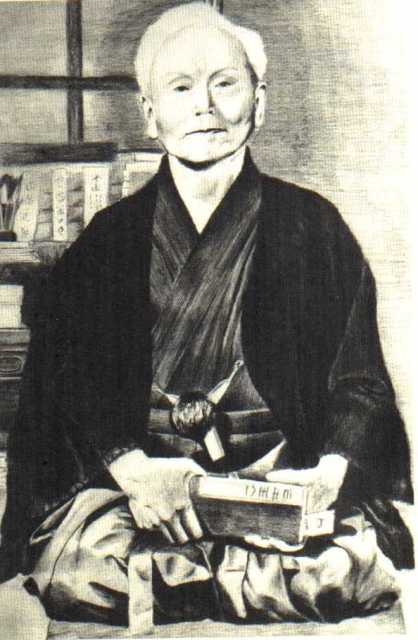
I think it was in Gichin Funakoshi’s autobiography that he introduced a bit of a riddle. He spoke about “the expansion and contraction of the body.” Karateka have been trying to figure out exactly what he meant ever since.
Some believe he was talking about extension and contraction of the muscles in executing a technique. You extend a punch, then retract it by contracting the opposing muscles – triceps out, biceps back.
Others have speculated that he meant the expansion of the body in inhalation and its contraction during exhalation. Generally, we exhale for power, as when executing a punch. At other times, we inhale for power, such as in one of the moves near the end of the Shotokan version of Gojushiho Sho kata. The standard surface interpretation of this move holds that we inhale to expand our chests as we extend and raise both arms to break a bear hug.
A third interpretation is that it refers to the expansion and contraction of the distance between bodies in a fight or match. Smart, highly skilled fighters generally masterfully control the distance between them and their opponents, closing (contracting) the distance when attacking, then moving away out of range (expanding the distance) when defending.
I have no idea what he actually meant as he never, to my knowledge, clarified it. I’ve seen some who claimed to “know” what he meant. But in logic, there is a difference between “knowing” something and “believing” it. Knowing means you have objective proof, something like you could present to a judge in court. A belief generally lacks verification and its support lies merely upon a person’s opinion. And those who would put words into others mouths have historically been greatly off. (A famous case was when the Chinese unearthed the first copy of Sun Tzu’s Art of War and asked their greatest martial minds to fill in the gaps, where sections of the bamboo strips on which it had been written were badly damaged. When they later unearthed another copy, with the missing sections intact, they found that those who had confidently, in some case arrogantly, filled in the previously missing sections were far off.)
Funakoshi Sensei could have meant none of the three interpretations I’ve put forward. He could also have meant one of them, two of them, or all three.
Perhaps there were applications there that went beyond what he actually had in mind when he said it. Perhaps there were other meanings, things he was aware of but didn’t mean when he made this specific statement. Or, perhaps there could be interpretations, things to be taken from it, that even he didn’t realize at the time.
We acquire and expand our knowledge via three sources. One, instruction from others. Two, personal experience. And, three, analysis and reflection. In the case of “expansion and contraction”, I take all I can from it that is of value to me and my students.
Someone once asked a famous poet, Robert Browning I think, what he meant by a line in one of his poems. “What did it mean to you?” he asked in return. The woman went on for five minutes about all the things she had gotten from the line, most of it clearly things he never intended or realized were there. “That’s what I meant,” he told her.
Great minds are often more than just repositories of knowledge, they are often also mediums through which great visions are channeled. So, for me, the question isn’t “What did he mean by this?” but rather “What are all the useful bits I can take from it?”
Well, I’m starting to ramble so I will stop for now. Thanks again from your support. I truly appreciate it.

Friday, January 20, 2012

Email from an old student

Sorry to take so long in posting another installment. I’ve started a few stories and have been unhappy with each as they are thus far. I will post them as they come together.
But something happened this week that I would like to pass on to you guys. I received the following email from a former student – someone who trained with me in the early ‘70s. I’ll replace his real name with “John Doe” as I haven’t gotten permission from him to post it. (He didn’t turn me down. I just decided to pass it along today and didn’t have time to ask.) His email to me is as follows:
“Dear Sensei Jim, I was one of your students many years ago - 1970-1974. I will always value your teaching. It was an honor to be your student, sir. (John Doe), Lieutenant Colonel, Special Forces, Retired”
I sent him a response, thanking him for remembering me and taking the time to contact me after all these years. I was so proud of him and honored that I may have been instrumental in assisting him in some small way achieve success and survive at such a dangerous and worthy undertaking that there were tears in my eyes as I wrote it.
Over the years, I have received several such messages and treasure them. One was from a student who had been suffering from a secret drug addiction while a student and claimed I had given him the strength to overcome it and become successful in life. Another was failing at school, one report card had all F’s, and credited me with motivating him, and giving him the self-discipline to raise it to all A’s within one school year. (Several had drug related issues that karate helped them defeat.)
Gichin Funakoshi said we must practice our techniques as if our very lives depended upon the effectiveness of every rep. And that has always been my goal, to practice as I wanted to be able to throw something in a real encounter.
But something this week’s email from my former student helped remind me was the need, as instructors, to teach as if our students’ lives depended upon how and what we teach them – as they well may. To name but a few, we need to teach them to throw their techniques with speed, power, penetration, and extension. We need to condition their bodies to throw and receive strong attacks. They need to learn effective tactics and strategies that will enable them to capitalize upon their strengths and prevent their opponents from capitalizing upon their weaknesses. They need to be made mentally strong enough to continue fighting even when injured, as most will be in a real fight. Knowing what to do in a fight and being able to do it are two separate and distinct skills. So it’s critical we teach them both what to do and take them through drills that better prepare them for responding spontaneously to attacks.
I used to say that students learn more with their eyes than their ears. So how we behave, the role models we become or fail to become, effects how our students will behave themselves. Our strength, our ethics, our morality, our work ethic will become theirs. So we must always be some worthy of emulation.
Enough for this time. Thanks again for reading.

Tuesday, January 10, 2012

Hanshi Eihachi Ota's Three Questions

The following article was submitted by an old friend and long time karateka, Kyoshi Michael George. Thank you Kyoshi George for sharing this with us.


GM Jim Harrison (left), Kyoshi Mike George (center),
and GM Bob Yarnall (right)

A few years ago my friend Hanshi Eihachi Ota asked me to answer 3 questions. He said he would post my answers to his web page and did. If I answered these today, I might change a few things but not much. I know this is about Shorin Ryu, but others might find it helpful. The following are my answers:
Question 1. What improvements do we need for a successful Shorin Ryu style today?
Have an open mind. Bruce Lee once said “That the usefulness of a cup is in its emptiness.” To put it another way, “the usefulness of the mind is its openness.” I believe that we should strive to learn all that has come before and all that has been passed down to us from past teachers. But, we also need to be open to new knowledge and methods.
We need to…
• Be creative in the ways we teach.
• Find people who can be mentors and take advantage of their experience.
• Brainstorm with other teachers and coaches.
• Create a positive environment and team chemistry for our students to be a part of.
• Be good communicators.
• Teach our student to set goals for themselves - long term as well as short term. Process goals as well as outcomes.
Question 2. In your opinion, what are the mandatory characteristics of a Shorin Ryu role model and leader?
• He or she must be able to motivate and communicate.
• He or she should be as fit as age and health will allow. Students often come in to a new dojo looking to get in shape as well as to acquire self discipline. If the instructor is out of shape, what message is he or she sending to his students?
• Beginning students should always be taught tradition, as it is vital if they are to have a good start.
• A sensei should have a good understanding of the principles of his or her style and be able to plan and deliver meaningful instructions, taking into account the varying needs, interests and abilities of his/her students.
Question 3. What areas of knowledge must a Shorin Ryu practitioner have to be considered a master?
I have a problem with the notion that anyone ever really becomes a master. But I will try to give you my thoughts on what it takes to be considered a Renshi (one who knows), Kyoshi (one who teaches), and Hanshi (a model for the whole). A comparison may be made to our college and university system of degrees - Bachelor, Master, and PhD.
To start with he or she must know all kata and bunkai (application) for their system, as well as their system’s technical requirements. From this point, one is just getting started. I also feel that a person needs to be part sports psychologist, part personal trainer, and part student with an unending quest for knowledge.

Wednesday, January 4, 2012

What’s the most important thing in karate? – Part II

Just as a reminder, this is one of an occasional series of posts I’ll be writing in response to requests I cover some of the more basic material I taught when one of the coaches for the USA karate team at the Olympic Training Center in Colorado Springs. Also, some of the coming material will be from what I taught our grass-roots (dojo) coaches while I was co-head of the national Coaches Education Committee. These were the people who produced the athletes who fed into the USA Karate Team pool from which we drew those who represented the USA in international competition.
This post continues my discussion of the subject of distance control.
The value of distance rests on the principle that if someone can’t reach you, they can’t hurt you. If you stay beyond their reach, and prevent them from ever getting any closer, you're safe. If they have a weapon and you stay beyond the reach or range of that weapon, they shouldn’t be able to hurt you with it.
Obviously, such a distance cannot always be calculated, created, or maintained, due to a variety of factors, such as when sucker punched, attacked while in a confined or restricted space, a long-range weapon is produced unexpectedly, etc. I’m not speaking about those times or locations, only situations in which you will be given sufficient warning and space – principally during competition but at times on the street as well.
In the old days, most competitors lined up within striking range of each other, often toe to toe. These were “quick draw” contests that were often won quickly. (I won matches in less than five seconds and lost others equally fast.) Contests were ippon shobu, one point matches back then, where the first person to score a full point – or two half points – was declared the winner. From that distance, where both combatants were within easy reach, speed was the major determiner of the outcome. The general rule from that distance was that the person to fire first usually won. So speed became a critical factor. The faster man usually won.
I tell my students that they never want to allow genetics or luck to determine if they live or die. (A loss in the ring generally represents a competitive death – unless it’s a round-robin or double elimination event.) We have no control over either genetics or luck. So to prevent our survival from resting in the hands of one or both of these, we must espouse tactics and strategies that enable us to control the fighting environment in such a manner that things get tilted as strongly as possible in our direction, taking it out of the hands of genetics (superior speed or reach) or luck. One of the major tools for achieving this is distance control.
You never want to discover that an opponent is faster or armed the hard way, which is likely to happen if you allow an opponent to set up within their preferred range.
You want to force them to always stay just outside the reach of their longest body weapon. If you allow them to setup close enough for them to lash out with a jab or punch or front kick, for example, there are people out there so fast you will never see them move. You will only feel the impact. From this range, they can hit you in one motion, before you (as the Japanese say) can say “ah.” By keeping them outside the reach of their preferred techniques, you force them to take a step before launching their techniques, force them to use techniques that are not their best, or force them to launch their favorite techniques but in a different manner – ie, overextending it, etc. – creating a weakness. By forcing them to take a step before launching, you turn their techniques into two-beat actions. From closer range, everything lands on a single beat. This gives you no warning. It’s their speed against yours. By backing up a bit, forcing them to take a step before launching, you get the first beat as a warning (the technique will land on the 2nd beat), giving you an opportunity to evade, block, hit them, etc.
I’ll go into greater detail on this in future posts. Some people always try to find some flaw in anything, some situation they can image to "prove" a technique won’t work. One young guy once asked me, after an explanation like that above, “But what would you do if he had an atomic bomb? Your distance control wouldn’t work!” He looked at me like he was serious and wanted a serious defense of my position. I told him to do what they told us to do in the army, if an atomic bomb was detonated over a place where we did battle. If it was to the right, we flattened out backs against the dirt wall of our trench to the right. If it was to the left, we sat against the left, using the earth to shield us. But if it was directly overhead, we were to put our arms under our knees, grab our ears, pull our heads down, and kiss our butts goodbye!
Techniques are like tools in a toolbox. No one tool fits every situation. That’s why a good, journeyman carpenter (and good, journeyman martial artist) has many of them, different tools for different jobs. This is just one of them, there to be used when conditions are right.

Saturday, December 24, 2011

Happy Holidays!

Wish everyone a wonderful holidays with family and friends and a happy, healthy, and prosperous new year! I'll get back to posting again soon.